

By Milo Thompson. Images by Andrew Forsyth.
Whitehawk Hill wears its history. Carved into its surface is the Whitehawk Camp, a 5,500-year-old Stone Age earthwork. Brighton Racecourse traces a sharp line across its ridge, run by horses since the late 18th century. The hill has been a rifle range and a refuse tip. Today it is a nature reserve, threaded with footpaths that climb the hillside between blackberry bushes and young apple trees.
On a bright Sunday morning in late August, this storied hill assumed its latest role: the site of a football match to raise money for the children of Whitehawk.
Since 1999, Whitehawk Hill has been the looming backdrop to the Crew Club. What began as meetings in disused portacabins is now an award-winning community centre with programmes for children and adults.
In 2021, the club teamed up with VYD to form the Crew Club Hawks Youth Team. The Hawks support 60 local children across five age groups, with plans to add three more teams this year. VYD’s Life Goals project, which works to involve local women in football coaching, is also introducing two new girls’ sides.
On August 24, the match between a VYD team and the Crew Club Hawks adults raised money for the Hawks Youth Hardship Fund. The fund helps children who can’t afford to join to benefit from the confidence, friendship, and routine football can bring.

High above the Crew Club is the Whitehawk Hill transmitting station, a 45-metre-high metal monolith of radar dishes and latticed poles. It feeds the city’s TV and radio signals. It connects Brighton and Hove to the world.
This hill that connects is also a hill that divides. Whitehawk’s western edge marks a separation less tangible than geography but just as significant. By recent measures, Whitehawk is the city’s most deprived area. Across financial, educational, and mental health outcomes, its children fall well below the city average.
That is why the Crew Club Hawks matter so deeply — and why this match mattered too.
“The money raised means that families that can’t afford the fees can still play,” says Fred Sturgis, Head of Operations at VYD and the match’s organiser.
The benefits, for children and adults alike, are clear. “Football means kids can learn social skills and emotional skills whilst also staying fit,” says Fred. “Parents tell us that since joining the Hawks their child has become more outgoing, more confident, more able to say the things they want.”

Fred adds that “for the adults of Whitehawk, it helps create pride in the area. Parents chat on the sideline, set up sessions and help take the goals down at the end. Everyone is involved.”
On the morning of the 24th, the grass was dry and overgrown after a long summer. Curious dog walkers paused by the freshly painted lines; children leaned against garden fences and gathered on the pavement. Stray balls flew into brambles at the edge of the upper pitch sending players scrambling after them. Below, the Crew Club and its distinctive roof sat in the valley sloping towards the sea.
The game itself was quick and lively. VYD’s start was cautious — the team only had two out-and-out defenders — but soon grew in confidence. Before long, VYD had scored four. Two goals in quick succession from the Crew team before the break set up a competitive second half.
After an early penalty for Crew after the restart, a comeback looked possible. VYD soon regained their confidence, and a piece of individual brilliance towards the end of the match led to their fifth and final goal. The game ended 5-3.
For Fred, the day was a success. “I was so happy with how it went, there were so many good performances,” he says. “This is hopefully the first of many.”
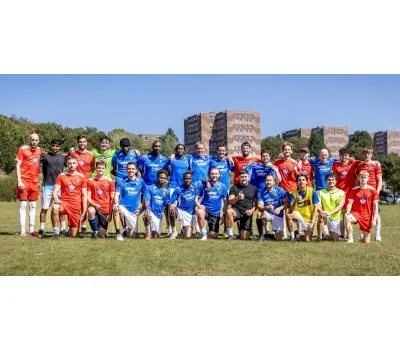
As the players shook hands after the final whistle, a shout came from the pavement asking who had won. The players, smiling now, called back the result. Competition faded into laughter as both teams gathered for a photograph. The money had been raised.

Just as Whitehawk Hill carries the marks of its history, so too does Whitehawk itself. Once pig farms and allotments, it became a relocation site during Brighton’s slum clearances of the 1920s. Over the decades, it became a canvas for council housing and urban planning philosophies: pre-war terraces, post-war high-rises, 1970s cul-de-sacs.
Yet what defines Whitehawk is its people. The parents and local residents that volunteer at the Crew Club. Players who come together to raise funds so that children who can’t afford sessions can still play. The social and psychological power of football is what keeps the club at the heart of the community.
The money raised by the match will be invaluable in keeping this work going, and the donation link is still open. If you are able to donate, please do. Every contribution, no matter how small, will help a child in Whitehawk play the game they love.
Special thanks go to Samson and the Crew Club Hawks.
Please donate here: https://www.gofundme.com/f/crew-club-hawks-hardship-fund